Research interests
My work sits at the intersection of artificial intelligence, natural language processing, and legal information systems. I study how models retrieve legal materials, rank evidence, and make entailment decisions under the constraints of legal language.
COLIEE 2026 — all five tasks
Team DU · official & post-competition results
Academic service
Reviewer · Expert Systems with Applications
Elsevier · October 2025
Completed one peer review for Expert Systems with Applications, an Elsevier journal on expert and intelligent systems applied worldwide.
 View certificate →
Academic service
Reviewer · Journal of Computational Law and Legal Technology
Bon View Publishing · September 2026
Completed a peer review for the Journal of Computational Law and Legal Technology, a journal on computational methods and AI for law, acknowledged by the Editor-in-Chief.
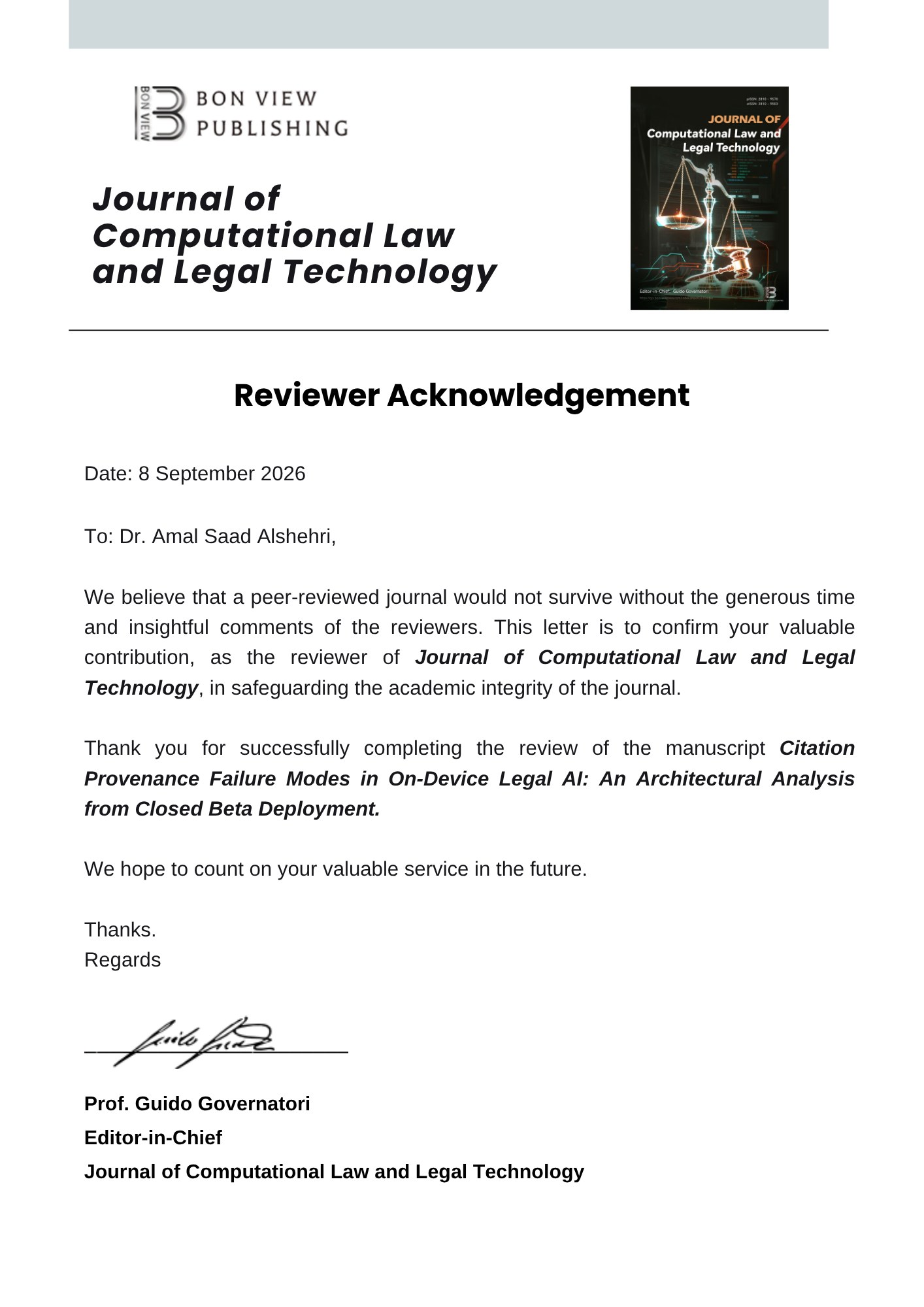 View acknowledgement →
Presentation
UKAIS 2026 · University of Sheffield
April 2026
Presented “Enhancing Trust in Legal AI: Optimising Span-Level Retrieval Architectures on LegalBench-RAG.”

